Sunday, June 19, 2011

Le Tour de France

This morning we emarked on what felt like the Tour de France. Today was the Fete du Velo, a day in which miles of roadway along the Loire River and countryside are shut down for bikers to make use of.


Our journey began with a ride from Angers to the river which was about 3 miles. We rode for a while alongside the river, passing quaint towns and beautiful scenery before stopping to have lunch. We walked our bikes to a secluded area and set up a picnic that our host mom had packed earlier this morning. We had fruits, madelines, and sandwiches(goat cheese, arugula, and prosciutto on a crusty baguette).


After lunch we biked further before crossing a bridge to the other side of the river. At the other end of the bridge was a small beach. Jill and I took a nap in the sand before getting back on the bikes.

This side of the river was far less populated and covered in hilly fields of wheat, asparagus, sunflowers, and grapes. There were long stretches of forests and pastures where several horses were grazing that we stopped and fed apples to.


We arrived home exhausted and proud of our 35 mile trek. For dinner, our host mom taught Jill and I how to make crepes. We took turns turning out the thin sheets of buttery goodness, customizing each one to our liking. Flavors ranged from goat cheese and prosciutto to egg and ham. For dessert crepes, I made the classic nutella and banana while Jill used a chocolate wine sauce on hers.

Saturday, June 18, 2011

The Perfect Saturday

We lazily awoke and had a light breakfast before heading to a wine cooperative in a nearby town with our host family. We tasted over twenty wines and to say I was a bit tipsy by the end of it would be an understatement. The wines we tried were all so different from the wines I typically drink back home. This tasting gave me a new appreciation for wine and more specifically, French wine. We sampled a regional specialty called Rose de Pamplemousse. It is a rose wine with a grapefruit liquor, something I will most definitely recreate in the states.


We ate a late lunch back Angers at La Tuscana. As we dined outside, our host dad pointed out a crowd of young guys coming down the street. One was dressed in leopard tights and a wig. He told us that this was a traditional custom in France for a bachelor's party.

After lunch, we attended a birthday party of Timoteo's friend who was turning three. It was fun to watch the interaction of the children as the birthday-boy opened up his gifts and ripped the toys out of the packaging. Everyone was extremely welcoming and enjoyable to talk to.

Once home, we played tennis with our host dad and biked home from the courts. It turned out to be quite a day.


Back to Brittany (June 17th)

On this day we headed back to Brittany to visit the salt marshes and a cheese/ dairy factory. Ten minutes on our way, we came across a burning car. There were no fire engines nor any on the way. The safety measure of choice- traffic cones.
 Our first stop was the Beillevaire Cheese Factory. We had an excellent tour along with a diverse tasting of different cheeses, raw milk, and wine. Against French law, Jill snuck some pictures of the workers.


For lunch, we stopped in the medieval village of Guerande. We walked around, stopping to shop at several  boutiques and bakeries. Jill and I split a flaky, salted-caramel pastry and I ventured into a local creperie for a pot of tea.

Our final stop for the day was the Terre de Sel salt marsh. There we learned about the process of producing salt using a maze of clay pools and a canal from the Atlantic Ocean. It was cold and miserable, but good to see. We got to speak to a director of a local salt co-op about salt production and the economics of salt farming.


That night, to combat the cold weather, our host family prepared raclettes, a typical French wintertime meal. Using a tabletop stove and small square pans, you melt a special cheese that you can pour over boiled potatoes or a crusty bread. This was served with an abundance of charcuterie, salad, and toppings such pickles and olive oil.  


Food Culture and Wine (June 16th)

Classes today proved to be the most interesting thus far. A lecture on American verses French food culture started off our day. Topics of national healthcare, obesity, school lunch programs, GMOs, fast/slow food,  and Terra Madre were discussed. I found it ironic that mussels and a plethora of other quality foods were being served that day, along with every other day of the week, in the cafeteria. Classes wrapped up with a lecture on 'terroir,' viticulture, and a wine tasting. Before tasting the wine, we all participated in a sensory activity where we smelled different bottles and racked out brains trying to identify the scents. My performance was quite a disappointment.

That evening, a group of us dinned at the Mexican restaurant we had found several days prior. The atmosphere was exactly like any Tex-Mex restaurant you would find in Texas yet the food was very different, but satisfying. Beans and pickled jalapenos made my night.

Wednesday, June 15, 2011

Maine Anjou Cattle Farm


This afternoon we visited a cattle farm with AOP status here in the Loire Valley. Appellation d’Origine Protégée(AOP) is a designation of quality by the European Union. It encompasses the product's geographic origin, quality, manner of production, and locality. In France, the majority of farmers raise purebred herds as opposed to America's preference to crossbreeds. The particular breed on the farm we visited today were Rouge des Pres(Maine Anjou). To uphold AOP status, farmers are limited to one animal for every two hectares of grass. This limit keeps his herd small, thus easier to manage. The animals leave a plush and long life here on Monsieur Arthus' farm. According to AOP rules, cows may not be slaughtered until after the birth of at least one calf. This deepens the color of the meat- a trait the French prefer over the paler hue of the beef we're use to in the United States.

Terroir and Typicity

The majority of my time today was spent in the classroom. Classes started off with French and then continued with lectures concerning quality labeling and intercropping. One of the professors spoke about typicity, a word I had never heard of until today. Sticking to basics, typicity is how similar a product is to the original/standard. It is typically used when comparing regional foods like certain types of cheeses, champagne, or wines. To demonstrate this concept, our professor brought in his French Coca-cola collection. Each region of France has its own off brand of the cola that is labled by the region's name with a unique taste. For example, Anjou Cola uses chamomile as an ingredient.


Along with the colas, the professor brought in two different camembert cheeses- one unpasteurized with TSG and PDO status(legal framework under EU law to protect the name of traditional food products) and the other, a standard pasteurized brand. The standard brand was extremely salty and lacked flavor while the unpasteurized camembert was immensely pungent and flavorful. 

For dinner, after aperitifs of charcuterie, wine, and nuts, our host mom prepared a quiche lorraine. It was a delicious quiche packed full of creme, ham, and cheese. It was paired with a watercress, apple, and beet salad which was followed by a cheese plate and fruit salad for dessert. Dinner conversation included a discussion on French humor which was very valuable to hear.

Monday, June 13, 2011

Normandy and Brittany

Our three day weekend began early Saturday morning on a bus headed for Normandy. Our first stop was a very special sheep farm where lambs are grazed on a salt marsh near the English Channel. This creates a superior product that can be sold for around 30 Euros/kilo as opposed to the standard New Zealand  reared lamb which is sold for 6 Euros/kilo.
View of Mount St. Michel from the Sheep Farm

Following the farm visit we traveled to Mount St. Michel, a rocky tidal island that has been the seat of the Saint-Michel monastery since the 8th century. It was a gothic structure that seemed to jet out of the rocky island it was built upon. The ascent to the monastery was steep but well worth the climb. A bottle of the local drink of choice, brut cider, helped ease the walking pains.


The following day we departed from Bayeux to Caen, the location of France's WWII museum. The exhibits were simple yet moving. The museum did an excellent job of pairing personal stories with the exhibit pieces.
The Death of a Hero
Repainting the Countries of Europe
   

                                                                                        Sections of the Berlin Wall


That same day, our group visited Omaha Beach and the American War Cemetery. It was a sombering experience that was only supplemented by the cold and wet weather. Thousands of immaculately white marble grave markers overlooked the very beaches on which Americans stormed sixty-seven years ago.

 
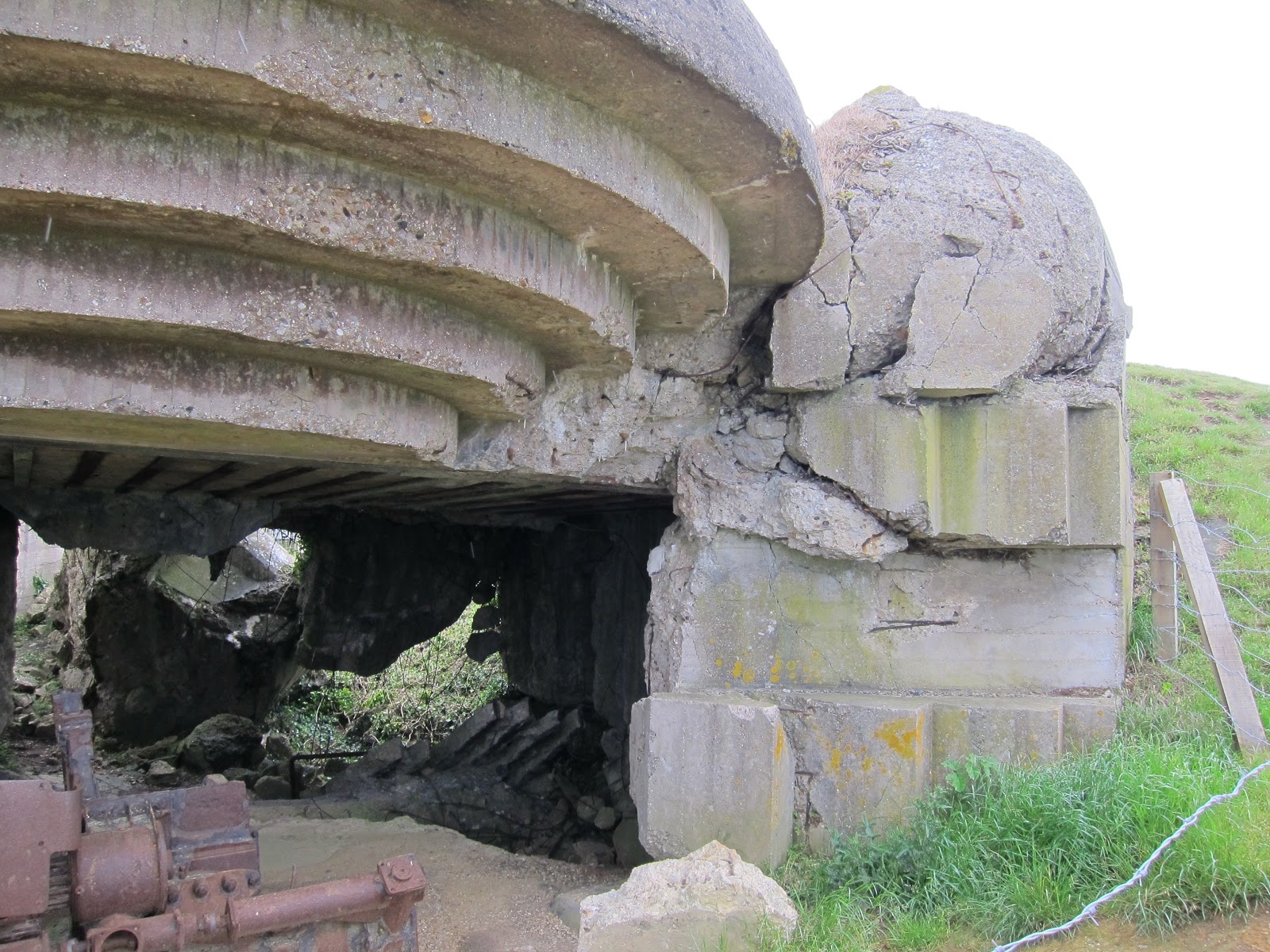
Twenty minutes away from the cemetery, we visited several Nazi bunkers perched within grassy fields alongside staggering cliffs. If not for our bus driver who lived locally, we would have known nothing of these bunkers. The site had few markings and was most definitely not on the tourists' map. All were given free reign to explore the bunkers and rusty artillery still inside. It was the highlight of my weekend.


A visit to the port town of St. Malo rounded out our weekend. Several of us descended the rocky incline to the beach where we explored the numerous tidal pools. After working up an appetite, we dined on a pot of steamed mussels and salmon plate at a cafe in the town before our stroll throughout the fortified city.